
"Ambitious for Scotland": Thoughts on the Scottish Government’s Programme from a company positioning to help
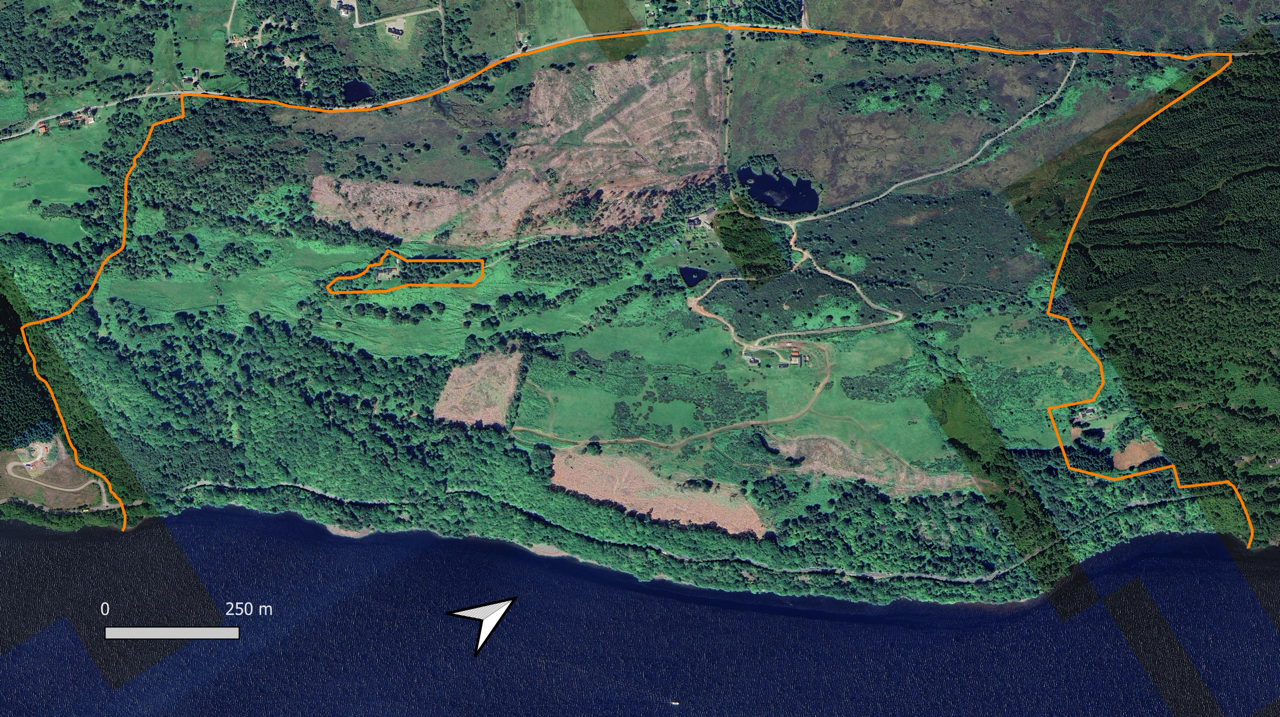
The NatureProsperity Resilience Reserve at South Bunloit
Written by Jeremy Leggett
On 1 September the First Minister set out the Scottish Government's Programme for Government for the new Parliament, "Ambitious for Scotland". The Programme foreshadows the need for three markets that my new investment company NatureProsperity is trying to help build. These are in nature recovery, sustainable forestry and affordable housebuilding.
The targets in the Programme tell the story of the desperate need to build these markets, and make clear their potential future enormity.
First, nature recovery. The Programme tells us that the Government will implement the Natural Environment (Scotland) Act 2026 and its statutory targets. This Act will place statutory duties on Scottish Ministers to establish legally binding nature restoration targets. These targets essentially put biodiversity on an equivalent legal footing to Scotland’s statutory climate targets. The framework aligns with the overarching Scottish Biodiversity Strategy to 2045, which commits Scotland to halting biodiversity loss and becoming nature-positive by 2030, and substantially restoring and regenerating biodiversity by 2045.
Second, sustainable forestry. The Programme tells us that the Government will facilitate the planting of 18,000 hectares of new woodland every year by 2029-30, at least 40% of which must comprise native species.
Third, affordable housing. The Programme tells us that 110,000 affordable homes will be built by 2032, at least 70% of them for social rent and 10% in rural and island communities.
Every one of those commitments is made in good faith, of that I am certain. But clearly we are barely in the foothills of building the markets that will be needed if they are to be met.
Equally clearly, public money will not close the gaps. What can close the gaps is private capital finding an ethical return in doing the right thing.
For that to happen major changes will be needed in how the markets are financed. The Programme makes this clear. It commits the Government to "investing in public and private finance" for the transition, to a Major Projects Office "unlocking private investment", to a strategic partnership between the new housing agency and the Scottish National Investment Bank to leverage "further private commercial capital", and, vitally, to "bring together private, public and third sector organisations to maximise the opportunities for nature restoration associated with the unprecedented investment in infrastructure development."
That last commitment is the most important sentence in the Programme for anyone with my vocational mission, and I will return to it shortly.
NatureProsperity is being built to help prove all three markets are investable, and investable in the vital context of a Just Transition. Let me take the three in turn, and how we are going about it.
1. Nature recovery
Highlands Rewilding, one of the four intended NatureProsperity portfolio companies, manages four Scottish estates and has spent six years measuring the baselines needed for natural-capital monetisation. That work is about to meet its first serious test. We expect a sale of biodiversity-inclusive carbon credits this autumn. This will be a first for us, and first of a kind in the embryonic market.
Why does that matter to the Programme for Government? Because of that infrastructure sentence. Scotland is in the middle of a huge grid and energy build-out, and the Programme now explicitly links that build-out to nature restoration opportunity. As things stand demand is insignificant and uncertain. Discretionary corporate goodwill exists, but is generally febrile, while compliance-driven demand by contrast is large scale. In Scotland, the reliable driver is the obligation that the official long-term spatial strategy and national planning policy places on nationally significant infrastructure. This policy is called National Planning Framework 4 (NPF4).
NPF4 means that the market-building opportunity is not abstract. It is that transmission, pumped storage and renewables developers, building in the Highlands over the next decade, need measured, credible, local nature outcomes, and Scotland has the ground and the science to supply them. What has been missing is a working market: standards, price discovery, and someone willing to go first.
The entire recorded global voluntary biodiversity credit market has sold under $7 million in its whole history. That is not a supply problem or an integrity problem. It is a demand problem.
I would add one uncomfortable fact. The entire recorded global voluntary biodiversity credit market has sold under $7 million in its whole history. That is not a supply problem or an integrity problem. It is a demand problem, and demand problems are solved by policy by first movers, which is exactly why the next twelve months - and the execution of the Programme for Government - matter so much.
Scotland has a huge opportunity here. It is not just about the building of a whole new market for the benefit of our national economy, it is about international leadership that can encourage others on the global scale needed to meet the targets most of the world’s governments agreed in the 2022 Kunming - Montreal Global Biodiversity Framework treaty.
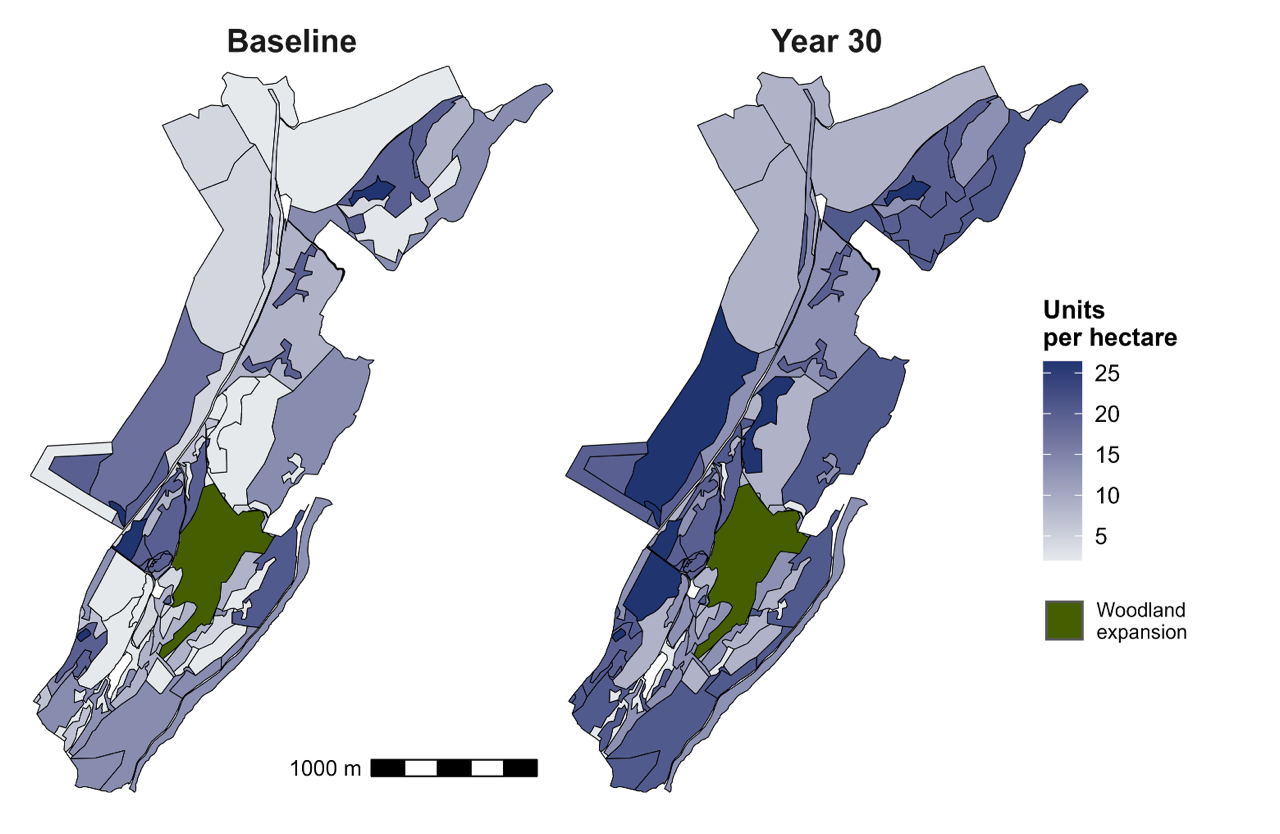
Baselining of the two Bunloit estates Highlands Rewilding manages, South and North: mapping of biodiversity uplift units using the English Biodiversity Net Gain System as a proxy for the forthcoming Scottish market framework.
2. Sustainable forestry
Here the gap between ambition and delivery is at its widest. The Programme targets 18,000 hectares of new woodland a year by 2029-30. Scotland created just 7,220 hectares in the year to 31 March 2026, down from 8,470 the year before. The Forestry Grant Scheme rose to £58.7 million for 2026-27, and Confor's assessment is that the grant pot stretches to roughly 10,000 hectares. So on current mechanisms we are running at 40% of the target, and the funding available cannot reach it even if every pound were spent with perfect efficiency. Clearly, grant making is never going to be the whole answer.
The 40% native commitment in the Programme is a signal worth reading carefully. Native, diverse, continuous-cover forestry is not just better for nature, it is more resilient. Diversity of species, age and structure reduces risk in a way that even-aged industrial monoculture does not.
NatureProsperity Forests and Timber, one of the two newcos in the NatureProsperity starting portfolio, is being built for exactly this ground: continuous-cover forestry, financed by private capital and credit revenue, with grants as upside rather than as a load-bearing assumption. Continuous cover is still only around 5% of Britain's forest area against roughly 22% across Europe. That gap is either an embarrassment or an opportunity, depending on whether anyone is willing to finance the transition. NatureProsperity aims to provide a vehicle attempting to do just that.
There is also a policy point worth flagging. The Programme proposes bringing SEPA, NatureScot, Zero Waste Scotland and potentially Scottish Forestry into a single environment body. Done well, that will be genuinely useful: one door instead of four for anyone trying to do integrated land, water and woodland work. Done badly, it costs two years of institutional memory at precisely the moment planting rates need to triple. The difference between those outcomes lies in the design and execution of the integration. A space to watch closely, and the best of luck to the civil servants leading this.
3. Affordable timber homes
This is where the Programme is boldest, and where I think Scottish manufacturing has most to gain.
The Programme intends 110,000 affordable homes by 2032. Of those, 10% must be in rural and island communities, which is around 11,000 homes in exactly the places conventional volume housebuilding serves worst. A new agency, More Homes Scotland, will be phased in from 1 April 2027, bringing funding, expertise and delivery tools under one roof, working in strategic partnership with SNIB to pull in private capital. Planning reform will speed delivery, the Programme says. This is vital. A Youth Built initiative will help young people build homes in their own communities. Also vital, and redolent with hope.
Now put beside that a date the Programme does not mention. From 31 March 2028, Scotland's new-build energy standard, the Scottish equivalent of Passivhaus, becomes mandatory. Every home in that 110,000 delivered after that date has to meet it.
MAKAR, the Highland manufacturer in the NatureProsperity portfolio, has been building to that level of performance for years now, providing homes made largely of Scottish timber, manufactured off-site in Inverness, erected in a matter of days, with very low running costs for the people who live in them. MAKAR is now bringing an affordable version of that product to market, and we expect its first order shortly from a community trust backed by Scottish Government funding.
MAKAR is a small company. It is not going to build 11,000 homes any time soon. But it does not have to. What it can do is prove a model, and the model is the point: rural homes (and urban too, for that matter), built from Scottish trees, by Scottish workers, to a standard that is optional today and compulsory in eighteen months, with the carbon banked in the building rather than emitted to put it up. There is now a UK standard for measuring exactly that, the Biogenic Stored Carbon Quotient published this May, which requires certified British timber. A MAKAR home is close to a worked example of it.
The alternative should worry us all. A housing emergency met with conventional carbon-intensive construction would deliver homes whilst torpedoing carbon budgets. I do not wish to appear cynical, but I fear the volume housebuilders may well try to do just that. The Programme for Government's own logic, decarbonising buildings by 2045 while delivering 110,000 homes by 2032, only closes if a serious share of that build is low-carbon by fabric, not retrofitted into compliance later at somebody's expense.
Why the three belong together
I call the combination of these three new markets the Nature Prosperity Pump.
Nature recovery generates revenue from restored land. That revenue helps finance sustainable forestry. Sustainable forestry grows harvestable timber. The timber becomes affordable homes, which bank carbon in their fabric and cut running costs for families. The homes house the workers who do the nature restoration, the sustainable forestry and the manufacturing, in the rural communities the Programme rightly calls "productive engines of economic growth". Value circulates within an increasingly resilient Scotland instead of leaking out of it.
For the economy, that means something specific. Not a subsidy line, but rural jobs that do not depend on annual grant rounds; import substitution, since Britain still imports the great majority of the timber it builds with; and an asset class that lets Scottish and international institutional money invest in Scottish nature at a scale that is currently impossible because nothing is packaged for it.
One CIO at a large insurer told me plainly this summer that NatureProsperity's £26 million Series A raise is too small for him. That is Scotland's problem in one sentence — a packaging problem, not an appetite problem.
What would help
Three things.
Demand certainty. Networks, renewables, and long-duration storage all live in regulatory frameworks (RIIO, contracts for difference and cap-and-floor respectively). Nature has no equivalent instrument in Scotland as yet, so every project is financed on the hope that a voluntary buyer turns up. Making the NPF4 nature obligation on major infrastructure explicit and inescapable would do more for Scottish nature finance than any new fund. It would be a compliance market by another name.
Treat private capital as delivery, not as decoration. The Programme's commitment to convene private, public and third sector organisations around infrastructure-linked nature restoration is the right instinct. Convene it early, and include the small companies actually doing the work, not only the institutions.
Make the rural 10% a manufacturing opportunity. 11,000 rural and island homes, procured with an eye to Scottish timber and Scottish factories, would build an industry rather than just a housing programme. More Homes Scotland is being designed now, and can figure this in.
NatureProsperity will be raising capital in the months ahead in order to play our part of this. We may succeed, we may fail. That is the risk any entrepreneur takes on a frontier. But the Programme for Government has just described, in the Government's own words and numbers, the country I and my colleagues have been building for, and today we fancy our changes of being able to help the Government build a new, resilient, nature-based and circular economy fit for the world we are living in.