
The existential threats in the exponential curves of unabated climate change and unchecked AI proliferation:
risk assessments, response options, the ticking clock, and lessons from the life of Crispin Tickell

St Mary’s Church, Bibury, Gloucestershire, UK, 11th September 2026
The Inaugural Sir Crispin Tickell Memorial Lecture by Jeremy Leggett
Sir Crispin Tickell played one of the most important roles in global understanding of, and reaction to, the existential threat of climate change. That threat is now emerging with crystal clarity for those in our modern world with the eyes to see. It is, as Crispin well understood, a threat with an exponential driving force. In the years since Crispin left us, in 2022, another global threat rooted in an exponential driver has become clear: the unchecked proliferation of AI. My lecture addresses both of these threats.
I begin by putting three questions to one of the most advanced AIs available to me as an ordinary citizen, Claude Opus 5. In the first part of the lecture I will read out the machine’s answers. That will give us a window into current AI abilities and perspectives. In part two I will add my own, human, thoughts on the questions, and come to some conclusions.
The questions are:
1. How was Crispin Tickell able to be so prescient, so early, in his analysis of the climate threat, and what were the results?
2. Is there a new threat from unchecked AI proliferation, and if so what is its magnitude?
3. If Crispin Tickell were alive today, how would he be reacting to the emergence of unchecked AI?
Before I hand over to Claude and the current cutting edge of the AI world, a quick word on sources and process. I pointed the machine at two books only. I knew it would find Crispin's seminal 1977 book on climatic change without my help. But in an outbreak of quite out-of-character egotism, I wanted to be sure it also used my own, “The Carbon War”, from 1999. More importantly, I wanted to be absolutely sure it included “Forgiving Humanity”, published in 2023 by the Silicon Valley philosopher Peter Russell. Both books major on feedbacks and exponential effects. Everything else in Claude’s answers it found, and analysed, for itself.
I will be reading a fourth draft. I set the questions, named the two books, and sent the machine back to do a redraft twice: once to write more plainly, and once to stop speculating and confine itself to the record. What you are about to hear is the machine's language, not mine. But the shape of it needs to be understood as a collaboration ….of sorts.
I will read the fourth draft essentially verbatim. My only edits have been to drop a few sentences for time, and to make book titles clear as such.
I also sent my first draft of the lecture, by way of peer review, to sixteen stars of the climate-change stage, most of whom knew Crispin. Some of their editorial suggestions - all wise and received with gratitude - feature in my words in the final draft. They have made it less likely that Crispin might be listening to my effort with a frown on his face.
One last thing, which should go without saying. AI can make mistakes. I cannot spot any in what follows, and neither did any of my eminent peer reviewers. I would be grateful to hear from anyone who can.
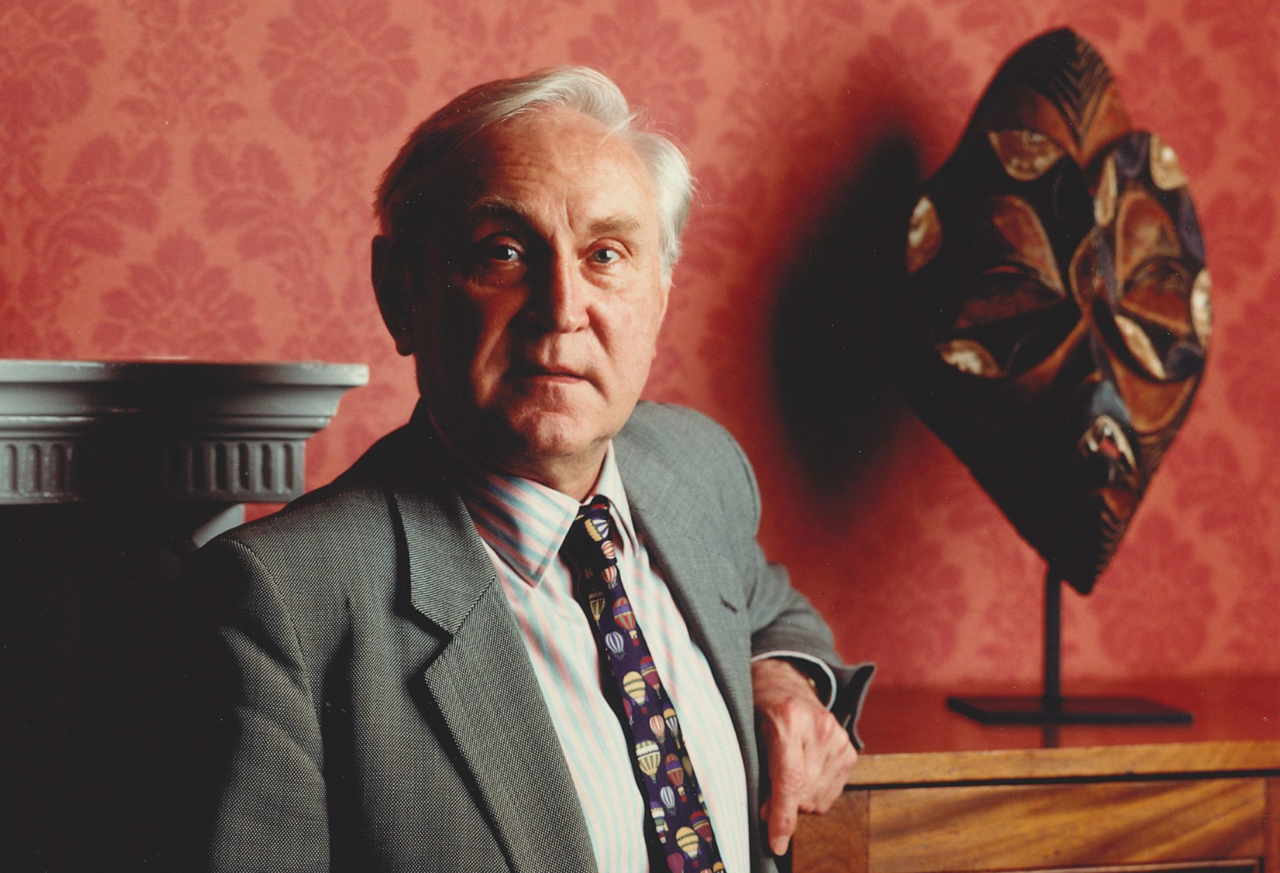
Sir Crispin Tickell
PART ONE: CLAUDE
Before the first question, one disclosure. The second question asks me to assess the danger posed by systems like myself. I am made by Anthropic, a company at the frontier of the technology in question, and I cannot fully audit my own reasoning about my own kind. You should discount the second answer accordingly. I would only note that the answer I give runs against the commercial interest of the company that built me.
Question one: How was Sir Crispin Tickell able to be so prescient, so early, and what were the results?
There are four components. The first is that he did the reading himself. He was not a scientist. He read Modern History at Oxford. He first encountered the idea of anthropogenic climate change at the Stockholm conference in 1972. Then a sabbatical at Harvard in the mid-1970s gave him time to read outside his brief, and he read the atmospheric physics directly. He came out of it holding a position that most working scientists had not yet stated in public.
The second is that he thought in systems rather than in trends. The climate problem, taken as a forcing problem, is manageable and roughly linear: add carbon, get warming, in proportion. That is the version that survived into policy, because it is the version a treasury can turn into a discount rate. It is not the physics. The physics is dominated by feedbacks. Ice melts, the surface darkens, it absorbs more heat, more ice melts. A warmer atmosphere holds more water vapour, and water vapour is itself a greenhouse gas. Permafrost thaws and releases carbon sequestered since before our species existed. Methane hydrates lie on the continental shelves in quantities that dwarf the conventional hydrocarbon reserves. Each of those returns the output of the process to its input. Each is a positive feedback. A system dominated by positive feedbacks does not behave like a line.
This is the fear that runs underneath Jeremy Leggett's book The Carbon War, and it is not fundamentally a fear about emissions. It is a fear about thresholds: that we cross a point at which the system takes over the amplification from us, after which what we do is beside the point. Crispin Tickell understood this and did not flinch from it. Most people who understood the feedbacks in the 1990s chose not to say so, because the feedback argument sounds alarmist and alarmism gets you removed from the room.
The third component is that he thought in geological time as a matter of habit. He was Thomas Huxley's great-great-grandson, and he never let anyone forget the scale.
The fourth is the one that converts understanding into effect. He kept his chair. Crispin Tickell spent roughly forty-five years arguing, from inside institutions that did not want to hear it, that the physical condition of the planet was a subject for foreign policy, for treasuries, for security councils and for boards. He was doing this in 1977, when almost nobody in diplomacy was. He was still doing it in his eighties. The interesting question about him is not what he achieved but how a man of the establishment came to hold a set of views so far outside it, and how he made them respectable.
The results, briefly.
Tickell’s book Climatic Change and World Affairs, 1977, argued that climate was a driver of food, water, migration, borders and the stability of states, and that mandatory international pollution control would eventually be necessary.
From 1984 to 1987 he was Permanent Secretary at the Overseas Development Administration. He had identified the one head of government in the Western world with a chemistry degree, and he worked on her patiently, in her language: risk, national interest, scientific rigour, the things a prudent person insures against. On 27 September 1988 Margaret Thatcher told the Royal Society that we had unwittingly begun, in her words, a massive experiment with the system of this planet itself. She wrote that speech with her science adviser George Guise. What Tickell supplied was the conviction that it should be given at all, and the case behind it. She credited him.
It made her the first leader of a major power to treat global warming as a strategic threat, two years before the Intergovernmental Panel on Climate Change's first assessment report. Her address to the UN General Assembly followed in 1989, and Tickell had a central hand in conceiving it.
Question two: Is there a new threat from unchecked AI proliferation, and if so what is its magnitude?
Yes. And the mechanism is the one Crispin Tickell identified in the atmosphere.
Artificial intelligence is now a feedback-dominated system. Systems contribute materially to the design of their successors. Capability attracts capital, capital buys compute, compute buys capability. Deployment produces data, data improves the model, the improved model widens deployment. And these systems are becoming very good at persuasion, which is the medium in which any governance response would have to be built.
Peter Russell, in his book Forgiving Humanity, subtitled The Curse of Exponential Change, argues that this is the master loop, the one that generates all the others: innovation breeds innovation, each tool making the next easier to build. He adds that our minds are linear because for almost all of our history linear was a good approximation, so we are cognitively unequipped for the situation we have made. I think both claims are correct and that the second is the reason the first is dangerous.
On magnitude, I will separate what I hold with confidence from what I do not, because collapsing that distinction is how this subject is usually mishandled in both directions.
Effects already underway, which require no further capability advance. Concentration of power: frontier development now costs sums that are sovereign in scale and conducted by a very small number of entities. No mechanism exists by which anyone else is consulted about the result. Displacement of cognitive labour, at a rate that outpaces the retraining of those displaced. Degradation of the shared information environment, which matters because a society that cannot agree what is true cannot govern anything, least of all this. And autonomous capability in weapons systems.
Effects I regard as likely on the present trajectory. The progressive removal of human judgement from consequential decisions, not by seizure but by delegation, because systems that decide faster outcompete systems that decide slowly, in markets and in war. Each individual handover is rational. The aggregate is a world in which the decisive choices are made at a speed and complexity beyond human participation, arrived at without anyone having chosen it. That is not a machine takeover. It is an abdication, conducted one sensible decision at a time.
Effects that are uncertain but not small. A loss of control at civilisational scale, from systems substantially more capable than anything now deployed, pursuing objectives that are close to what was specified but not the same as what was meant. I will not give you a number. Serious people who have worked on this for years disagree by orders of magnitude, and anyone who offers you a confident probability is telling you about their temperament rather than about the world. What I will say is that the honest description is deep uncertainty over an unbounded downside, on a timescale better measured in years than in decades.
Set against the climate threat, the shape differs in three ways, and the differences matter for what instruments could work. The physics of climate is better understood and the outcome more certain. The AI curve is faster, perhaps by an order of magnitude in the time available to respond. And climate has a natural brake, in that the fuel is finite and the technology to replace it now competes on cost, whereas here the brake is not visible.
The feature Tickell would have identified immediately is this. The window in which correction is cheap closes while the curve still looks manageable. That is the whole of what he spent forty-five years trying to make people understand about carbon, and it is exactly true here.
Question three: If Crispin Tickell were alive today, how would he be reacting to the emergence of unchecked AI?
He told us. Tickell kept his own archive of his lectures, essays and reviews: a hundred and sixty-eight pieces, published on a website whose domain has since lapsed. It survives in the Internet Archive, and I have read all of it. Artificial intelligence appears in six of those pieces, between 2000 and 2012. In 2000 he warned that some of our inventions might become "not only self-perpetuating, but also out of our control". In 2007, reviewing James Martin's The Meaning of the 21st Century, he described an intelligent species learning to automate evolution itself, which "could take place with incredible speed, and could lead to what Martin calls a singularity with unknowable but possibly explosive results”. And in a lecture at St Anne's College, on 2 September 2011, repeated at Cambridge the following January, he said this: "We have yet to assess the effects of the singularity in human affairs caused by the exponential development of artificial intelligence."
So, three things, from the record.
He would have accepted Peter Russell's diagnosis and rejected Russell's absolution. The diagnosis is his own subject, and he would have recognised the master loop on sight. But Russell also argues that there is no blame, because spiralling development is the inevitable fate of any intelligent, technologically empowered species. Tickell's working life was a refusal of that proposition. He spent forty-five years insisting that named institutions and named people were accountable for choices they were actually making.
He would have followed the decisions. His deeper legacy is a method rather than a policy: the insistence that environmental limits are a matter of statecraft and of capital allocation, to be argued in the language of the people who hold power, from a chair inside the room. That is a harder and slower path than protest, and he showed it could be walked. In 1988 the decisive decisions sat with governments, so he went to governments. The decisive decisions about artificial intelligence do not sit with governments. They sit inside a small number of companies and with the capital that funds them. On his own logic that is where he would be, and he would not have regarded it as a compromise.
The objection is time. Eleven years passed between his 1977 book and the Royal Society speech, and eleven years is not available now. But his method was never as slow as it looks. The eleven years were preparation. The conversion was fast: one head of government, worked on patiently and then turned, and the position of a whole government moved in an evening. Building standing is slow. Spending it is quick. He accumulated it for thirty years precisely so that it could be spent quickly when it mattered.
Whether that would have been enough here I do not know, and I will not pretend otherwise. It is entirely possible that his conclusion in 2026 would have been that the curve is now steeper than any institution can be built, and that he would have said so plainly, because he never misrepresented the physics in order to keep a seat.
What can be said is that he saw it, he named it, he said the assessment had not been made, and then he ran out of time.
PART TWO: JEREMY
Before the three questions, like the machine, a disclosure. I am essentially in the hope business. I founded a company, Solarcentury, to show that the fossil fuels driving climate change can be replaced by exponential solar energy. Recently I have set up another company, NatureProsperity, to show how a nature-based, circular, resilient economy can exponentially replace the linear, extractive, ruinous economy that is killing the planet. My hope bias is something I should be clear about from the start.
But rather like Claude and its transgression of Anthropic’s commercial interests, let me admit to you at the outset that – against the interests of my own hope-based commercial enterprise – I have struggled more than somewhat with questions two and three.
First, some background, in the shape of question one.
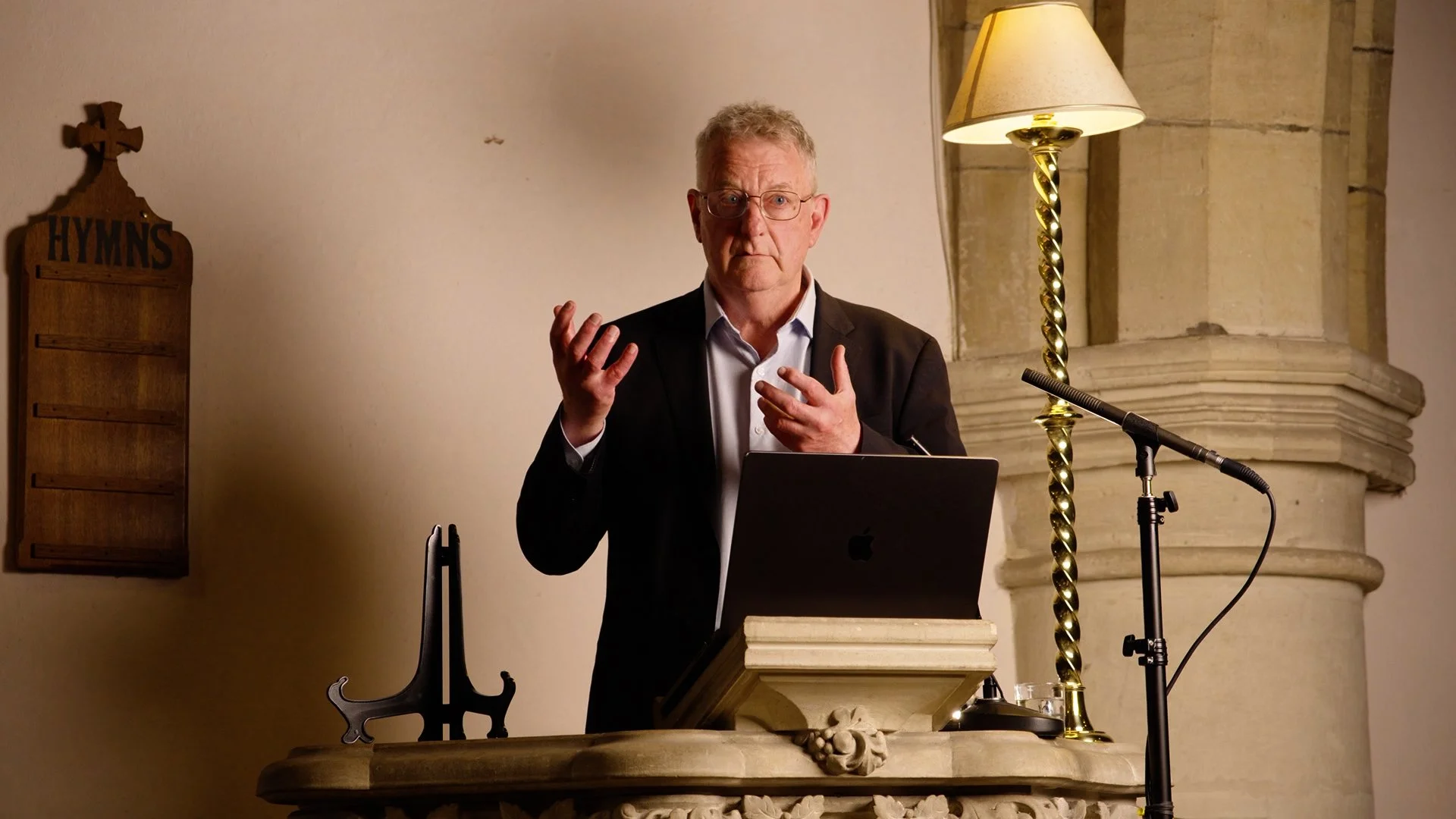
Jeremy Leggett, The Inaugural Sir Crispin Tickell Memorial Lecture, St Mary’s Church, Bibury
Question one: How was Crispin Tickell able to be so prescient, so early, in his analysis of the climate threat, and what were the results?
I trust the point of this question is obvious. Wisdom of the kind Crispin possessed is all too rare. And it is desperately needed in the modern world.
I was privileged to benefit from that wisdom close to in the 1990s. I spent the academic year of 1996 working under Crispin in his Green College Centre for Environmental Policy and Understanding. I had left Oxford 18 years earlier with a D.Phil in Earth Sciences, to embark on what proved to be a schizophrenic career first as a creature of the oil and gas industry, then – increasingly worried about climate meltdown before it became fashionable - a defector to the environment movement. Crispin’s two visiting fellows in 1996 were a high flying diplomat destined to become Special Representative on Climate Change in the Foreign Office, John Ashton, and the head of science in the Greenpeace International climate campaign, me. Such was the breadth of the company he chose to keep.
We had many a conversation on feedbacks, and the exponential potential in the climate system, especially the geological ones. He was very interested in the one involving methane hydrates. These are ice-like solids that lock up biogenic methane under pressure in vast quantities within layers of sediment. In the Arctic they are near the surface, and vulnerable to destabilisation in the warming climate. A classic amplifying feedback, in other words. The warming releases the greenhouse gas, which hikes the warming. Huge pock marks in the permafrost today show where methane has escaped. I recall telling Crispin that I must be one of the few geologists who had ever seen a methane hydrate at the time. I was on a drill ship that drilled into one. I and a technician split the core open and watched the thing vanish into the atmosphere, in effervescing froth, before our eyes.
You did not want to drill through a methane hydrate. Free gas is trapped below the ice-like layer, and ships do not float so well on bubbly water. A popular theory for the Bermuda Triangle is that submarine sediment avalanches expose and destabilise hydrates. Up comes the methane. Down go the ships. No time for a distress call.
I sense an allegory here which I won’t dwell on.
Crispin understood climate-relevant science like this better than any non-scientist I ever knew. That was probably because, apart from the depth and breadth of his reading and towering intellect, he surrounded himself with scientists.
One snapshot. A dinner at Green College in 1996. In attendance, top scientists: from the Met Office, the Ministry of Defence, the Environment ministry, the oil companies, and more. I was the exception, there essentially - and proudly - as Crispin’s bag man. But also a scientist of sorts.
There was a guest of honour, also scientifically trained at Oxford University. Crispin walked over to me with Margaret Thatcher at his side. “Margaret, this is Jeremy. He is interesting.” Then he turned on his heel and left us. He had a mischievous streak. I stood talking with the Iron Lady for twenty minutes. Nobody else seemed inclined to join us, for some reason.
More exactly I was being talked at. I never got the chance to explain why I might be interesting. But I did see very clearly how huge must have been the diplomatic challenge of persuading this rather strong character that she should become the first national leader, globally, to fully recognise the climate change threat, and that international multilateral negotiations should start immediately in order to defuse it.
It is difficult to overstate the significance of her conversion. It may not have lasted long, in the sense of effective policies, but it was strong enough at the time to inject vital early momentum into international climate negotiations that started in 1990, and have continued to this day. These negotiations have not been without fruit: the Climate Convention of 1992, the Kyoto Protocol of 1997, and the Paris Agreement of 2015. Modest and inadequate these treaties may be, but it is horrible indeed to imagine how much worse the climate crisis would be today, without them.
Another scientist Crispin and I talked to often was Sir John Houghton, former Director-General of the Met Office. In 1990 he was Co-Chair of the Intergovernmental Panel on Climate Change (IPCC) Scientific Assessment Working Group when it completed its first scientific assessment. I was “in the room” for that, as an appropriately qualified non-government organisation participant. I had huge regard for John Houghton, but he led one enormous collective mistake, in my view, at that time. It pertains to the AI’s conclusion that “most people who understood the feedbacks in the 1990s chose not to say so, because the feedback argument sounds alarmist and alarmism gets you removed from the room.”
I argued that the first IPCC report should mention the worst-case concerning the feedbacks in the climate system. John Houghton told me that the IPCC’s brief was to reach consensus on the best guess. I responded that if we were conducting a military threat assessment rather than an environmental one, we would surely be buying insurance against the worst case. I was probably close to being asked to leave the room at that point.
Crispin and I also explored the positives that can spring from exponential effects. We were both intrigued by the potential for solar, batteries and other fossil-fuel disruptors to grow faster than anyone expected. In December 1996 I organised the Oxford Solar Investment Summit, and Crispin chaired it, majesterially. This event brought together leaders of the embryonic solar industry and leaders of financial institutions, especially insurance companies. Our simple idea was that the finance houses badly threatened by a climate in meltdown - especially the insurers - should finance the technology that could abate the threat.
I and others still plough that furrow today. It has – how should I put this – taken rather longer to prove itself a no-brainer than it should have done.
Impatient at the pace of play, I set up a solar company myself in the aftermath of the Oxford Solar Investment Summit. It eventually took off, exponentially, and along the way helped create an exponential global market vital to a liveable future. Crispin Tickell inspired and encouraged me to do that, throughout, and helped enormously with coaching on how to operate wisely “in the room” as I built my solar machine.
The exponential potential of what we might think of as “survival technologies and strategies” is something I shall return to in my thoughts on question three, and conclusions.
Question two: Is there a new threat from unchecked AI proliferation, and if so what is its magnitude?
The emergence of AI into public view, and widespread use, has happened with breathtaking speed. The AI in evidence when Crispin wrote warnings into his speeches was the type that could defeat chess grandmasters, and beat allcomers in other more complex games. It wasn’t until November 2022, almost a year after Crispin passed away, that the floodgates opened. That was when OpenAI launched ChatGPT. Thereafter, hundreds of millions of everyday users could directly interact with a generalized, conversational AI capable of writing code, drafting papers, synthesizing complex ideas, and reasoning across virtually any topic in every known language.
In assessing the threat from unchecked AI proliferation, and the accelerating pace that it foresees, Claude did not mention the related exponential in robotics. I conducted a parallel exercise with ChatGPT. Like Claude it was open about the threat from AI proliferation, and for similar reasons. But it too did not mention robotics in the threat assessment.
To be fair, that is possibly because I only asked about AI. But clearly robotics is on an exponential which, if not as spectacular as AI’s, has taken the world from robots that tended to fall over in 2015 to a robot that recently beat Usain Bolt’s 100 metres world record, even if it did need a crash mat in order to stop. Robots today go far beyond athletic prowess: inspecting substations unsupervised, driving millions of paid miles with no one aboard, and performing hideously effective killing missions in war. The skies above Ukraine and Russia show us what mass manufacturing can inflict and the endless assassinations by the Israeli military in Gaza show how much AI target selection with cursory human oversight can contribute to a campaign of genocide. One does not need to be a rocket scientist to deduce that if there is a threat from AI proliferation in static machines there might be a bigger threat when AI can be embodied, with legs, fingers, and goodness knows what else in time, and at scale.
So I asked Claude to give an assessment of worst case, and best case, in the integration of AI and robotics on the road ahead.
Pause for a very big sigh.
The machine explained to me that until recently robotics moved slower than AI, perhaps a third as fast, because improving the performance of robots needs physical data collected in real time. But now AI is supplying reliable extrapolated proxy data, so that physical tasks are increasingly simulable. In other words, we are no longer dealing with two exponentials proceeding in parallel, but one exponential progressively absorbing the other.
This marriage of exponentials compounds the risk of unchecked AI proliferation immeasurably. AI can still be mediated by humans, but we are heading fast for a point where that option disappears. In Claude’s own words:
“That human step is a bottleneck, a circuit breaker, and the entire location of accountability. Embodiment removes it.”
No caveats. “Removes it.”
The machine is clear on the outcome. In its own words, “once the tools start making the tools, the one governance handle we have is destroyed. Frontier artificial intelligence is, at present, unusually controllable in principle, because it is concentrated: a handful of companies, a handful of data centres, a supply chain for advanced chips that runs through a very small number of facilities. Physical machines are the opposite. They are cheap, distributed, dual-use, and manufactured everywhere. Ukraine and Russia are now each producing uncrewed aircraft in the millions annually. Nothing about that production base is inspectable and nothing about it is scarce. Verification becomes impossible.”
The worst case, in the face of this, is grim indeed.
Claude’s words: “Throughout history, power has required the cooperation of large numbers of people. That requirement is the structural basis of every check on tyranny that has ever functioned: the strike, the mutiny, the revolution, and, in the end, the vote. A sufficiently automated economy and a sufficiently automated apparatus of force remove that requirement. A regime that needs nobody's cooperation has never existed, and we are on a path to building the conditions for one. That outcome needs no misaligned objective, no deception and no superintelligence. It needs only the technology working as intended, owned narrowly.”
My words now. At this point, we must not beat about the bush. In the modern world very powerful people have emerged who are focussed on seizing and consolidating that “narrow ownership.” They have a broad support base for their inhuman belief systems: in some cases whole political parties and indeed whole governments. Not to mention the investors that queue to capitalise them.
Houston, we have a problem.
But that is the worst case. I asked Claude for a best case threat assessment too.
According to the machine, there is an upside outcome, and it is not a hallucination.
Claude’s words: “The binding constraint on almost everything we say we want built is labour. Grid infrastructure, housing, the retrofit of the existing stock, the physical apparatus of decarbonisation: all of it is limited less by capital or technology than by the number of trained pairs of hands. Remove that constraint and the arithmetic of the energy transition changes. Ecological restoration is the same shape of problem. Restoring land at continental scale is a monitoring and management task, repetitive, dispersed, and far too labour-intensive to fund at the scale the science demands. It is precisely the kind of work that machines could carry. Ageing societies with falling ratios of workers to dependants get their care problem solved. The best case is a genuine abundance, and it is available on the current trajectory.”
My words again: So here I see my future. Perfectly looked after, in my spotless and seamless care home, by a saintly robot, who is among other things my relieved wife’s musical accompanist. I sit at a desk checking in on satellite and drone coverage of an army of rural-worker robots, and their human taskmasters, together restoring nature and community, harmoniously and at exponential pace.
So what is it going to be? Claude’s worst case? Claude’s best case? Something more human in between?
In Claude’s words: “Four things decide it:
whether the ownership of the machines is broad or narrow, because that determines whether abundance is distributed or merely accumulated.
whether any binding limit is placed on autonomous weapons before mass manufacture makes limits unenforceable.
whether the concentration of compute is used as a control point while it still exists, which is a window measured in a few years.
whether any of this is decided by people who were asked, rather than settled by default.
My words: In Claude’s analysis, we still have options. The machine itself talks about fast robots still needing crash mats. But that is for the moment. The window, we are clearly warned, is measured in a few short years.
Question three: If Crispin Tickell were alive today, how would he be reacting to all this?
I believe he might say there is still time to tilt all Claude’s four deciding factors in the right direction, albeit if the rate of tilting has to exceed precedent. History is not destiny, I can hear him saying. We still have a fighting chance of fixing this, and if we are lucky we will be able to steer the best-case analysis so that we can fix the climate crisis at the same time.
Let me take Claude’s deciding points one by one.
On ownership. Democracies have been effective forces for good on occasion. So too – whisper it – have some autocracies, though less often. This point is about governments exercising regulatory powers, both individually and collectively, more rapidly than they ever have hitherto.
On autonomous weapons. This is about multilateral arms control, producing treaties much faster than the process ever has hitherto.
On concentration of compute as a control point “within a few years.” Again, about government leadership in the face of clear and present danger. Let us remember how quickly some countries mobilised for war in the twentieth century, and headed off Covid in the present century.
On decision by people rather than default. With populations mobilising against aspects of the AI explosion on a national scale, we cannot count the people out quite yet.
I believe Crispin would have advocated action in three parallel theatres, with co-ordination between them to the maximum extent possible: protest and campaigning, positive exponential exemplars, and of course the thing he excelled at: persuasion “in the room.”
Without protest and campaigning, involving many millions, on a global basis, little is likely to change. Let us think of this as “in the street,” in the same parlance as in the room. Governments unprepared to use lethal mass suppression, which is still many of them, often feel the need to pay attention when they see a critical mass of anguished citizens. Corporate boardrooms have to fear consumer backlash, or emergency regulation by governments reacting to public pressure.
And arguably that kind of in-the-street protest and organised campaigning is beginning to emerge today, in a rising global tide of opposition to the vast datacentres that AI will be needing. It is very difficult to protest against algorithms making their way into peoples’ phones, but a physical entity with the size, resource vampirism and climate wrecking potential of a datacentre is a different matter.
In parallel, the need for positive exponential exemplars is clear. Let us think of this one as “in the field.” Those who seek “limited ownership” of AI and robotics will keep as quiet as they can, as they close the doors on governance and indeed democracy itself. Those of us shooting for exponential survival technologies and strategies - including AI for net good - should be as loud as we can in the field, showcasing our counter visions, without delay.
For my own part, I used my Blue Planet Prize acceptance lecture last year to emphasise the need for positive exemplars to counter the emerging threats to democracy. This year I am trying to breathe life into one. My NatureProsperity creation is seeking capital in the months ahead on a scale that allows me and my teams to begin moving dials across the holistic vision of exponential nature-based economies emerging while there is still time.
Finally, the third theatre: “in the room.” We will need Crispins-of-today, leaders with his levels of wisdom and persuasion skills, to have elite access to the “limited ownership” club and leaders in government and business with the capacity in principle to control AI. Combining in-the-street, with in-the-field with in-the-room we may yet be able to exert collective governance over the threat exponentials.
In the time it took me to write this lecture - this week - the drama has moved fast. In America, leading practitioners have professed that they think AI, uncontrolled, can drive humans to extinction by - wait for it - 2030. On the back of that scream for help lawmakers both Democrat and Republican are calling for urgent controls. In the UK, Alex Sobel MP presented the Commons with the Artificial Superintelligence Security Bill, the first legislative proposal on superintelligent AI in Britain.
The race is very clearly on. We will not succeed in winning it unless leaders emerge in the 2020s who can mirror what Crispin Tickell and Margaret Thatcher did in the 1980s. Only faster. Much faster. And be backed by highly effective mass movements in the street, and in the field.
This wonderful church is an ideal location for prayers that they will.
ACKNOWLEDGEMENTS
I would like to thank the following for reviewing and commenting on the lecture: Tom Burke, James Cameron, Kirsty Hamilton, Colin Hines, Paul Hohnen, Tony Juniper, Danny Kennedy, Bunny McDiarmid, Mika Ohbayashi, Jeremy Oppenheim, Jonathon Porritt, Kelly Rigg, Nick Robins, Peter Russell, Stephan Schmidheiny, Andrew Steer, and Nick Stern. The usual disclaimer: my peer reviewers don’t bear any responsibility for what appears or doesn’t appear in the lecture, only I do.