
Forty years of warnings, six tonnes at a time
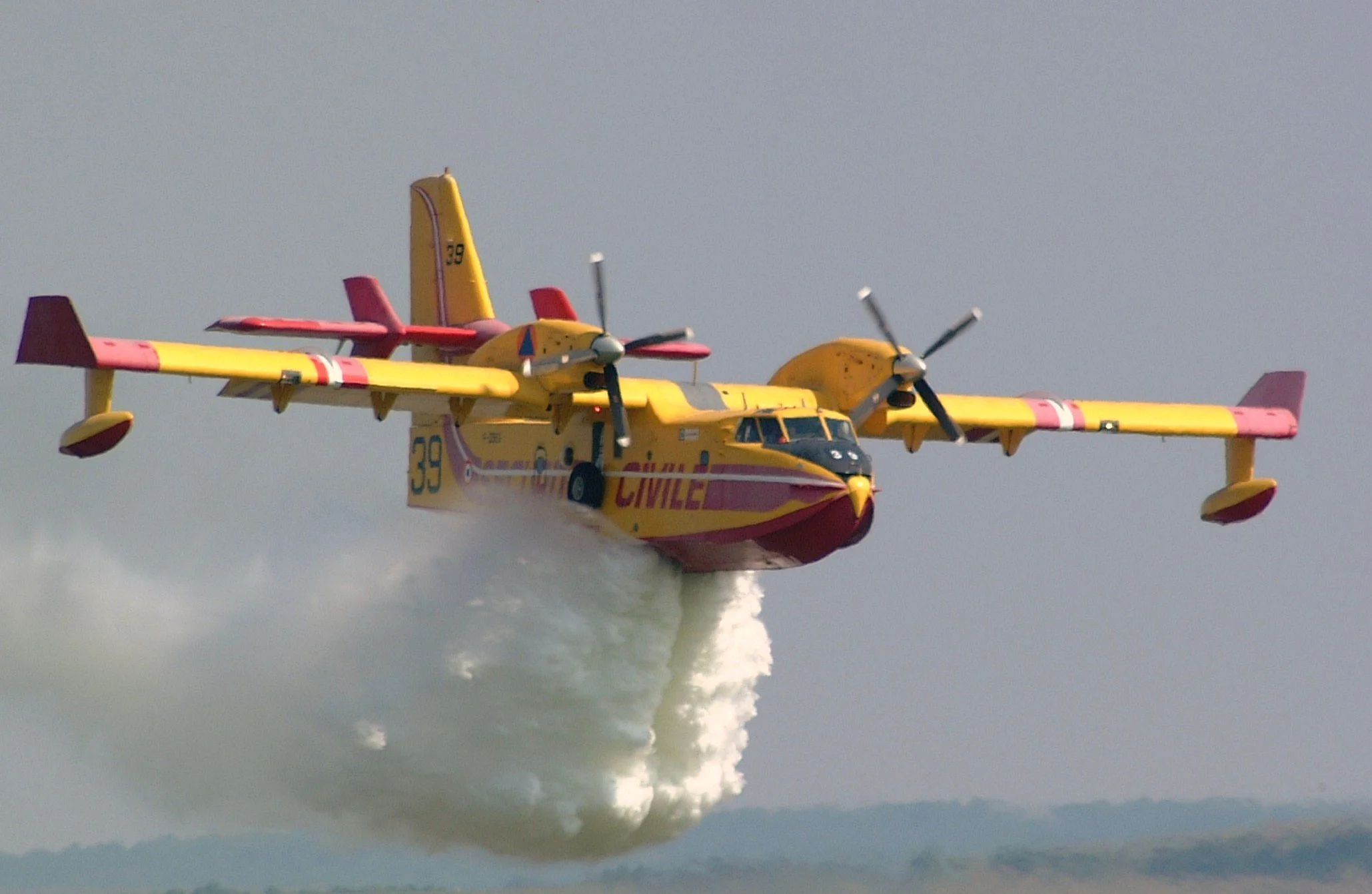
Photo credit: Canadair CL-415 F-ZBEG Securité Civile (Dropping its load) by Jerry Gunner, licensed under CC BY 2.0. Via Wikimedia Commons.
Written by Jeremy Leggett
From where I am staying beside the Rhone in Provence, it feels like living at the end of a bomber-base runway in the Second World War. Smoke stands on the ridges to the south. Every few minutes another of the yellow Canadairs drops out of the glare, flattens out low over the river, and ploughs a long white furrow across it, ramming six tonnes of water into its tanks without ever quite landing. Then it heaves itself back into the air, clears the pines, banks, and turns for the fires in the hills. Drop. Return. Reload. The loop has been running since dawn, aircraft after aircraft, and the sound never quite stops. It would make a fine airshow, were it not a battle.
Those aircraft are a data series with wings. France flies twelve of them, most delivered in the mid-1990s and now around thirty years old. During parts of the summer of 2024, a French Senate budget report recorded, the country's ageing water-bomber fleet was at times reduced to only four serviceable aircraft of any type, compromising its ability to fight several large fires at once. France's state auditor warned in 2022 that fire risk is expanding in both space and time: seasons lengthening, alerts spreading north beyond the traditional zones. This year is proving the auditor right. By the first week of July, France had burned 2.4 times its full-year average of the past two decades, according to the EU's satellite fire monitors. The five worst French fire years in the 21-year satellite record have all come since 2019. Across the EU, 2025 was the worst fire season in the satellite record that began in 2006: more than a million hectares gone.
For a generation, firefighting improved fast enough to turn the tide: burned area across Mediterranean Europe fell by about two-thirds between 1985 and 2011, driven in large part by better fire suppression. What has changed is the weather the crews now fly into. The global fire-weather season lengthened by 27 per cent between 1979 and 2019, and days of extreme fire weather rose by more than half. In the Mediterranean, fire weather has already emerged beyond the range of natural variability.
The line held for a generation. It is breaking now.
The UK, meanwhile, is in its third official heatwave of the year, and it is the first week of July. June brought a provisional record of 37.7C in Norfolk; the old June record, 35.6C, had stood since 1976. Attribution scientists can now put numbers on all this: human-caused warming made the June 2025 heatwave in southeast England 2 to 4 degrees hotter, and turned a once-in-fifty-years event into a once-in-five.
Why is this happening? No mystery remains. 2024 was the warmest year in the instrumental record. Carbon dioxide passed 430 parts per million for the first time in 2025. Fossil-fuel emissions set yet another record last year, an estimated 38.1 billion tonnes, and the remaining budget consistent with 1.5C, about 170 billion tonnes according to the Global Carbon Project, amounts to roughly four years at current rates. The ocean set its ninth consecutive annual heat record in 2025. As for the human cost: peer-reviewed analysis counts 61,672 heat-related deaths in Europe in the summer of 2022 alone. Munich Re priced the natural catastrophes of 2024 at 320 billion dollars, titled "climate change is showing its claws". That is not a campaigner speaking. It is a reinsurer, reading its own ledger.
None of this is a surprise, and that is my point. In 1979, the first World Climate Conference called on governments to "foresee and prevent potential man-made changes in climate". In 1988, NASA's James Hansen told the US Senate the warming was real "with 99 percent confidence", and the IPCC was created. Its 1990 assessment led to the Rio treaty, then Kyoto, then Paris.
I have watched this story from both sides. Through the 1980s I was a geologist at Imperial College, my research funded by oil companies. In 1989 I resigned and crossed to Greenpeace, where I was scientific director of the climate campaign through the years the treaties were being fought over. I saw how the incumbency fought then. They fight still. And we now know, from a peer-reviewed audit of internal documents, that from 1977 onwards Exxon's own scientists projected the warming with striking accuracy: between 63 and 83 per cent of their projections matched the temperatures that actually followed. The industry's science was right all along. Its public words were otherwise.
Pessimists will say it is too late to matter. I think they are wrong. I base my case, as ever, on analogous experience. The solar company I founded in 1997, Solarcentury, doubled its installed capacity eleven times between 2000 and 2019, riding a global boom almost every pundit said was impossible. Capital moved, first from angels, then from institutions, and an expensive marginal technology became the cheapest new electricity in much of the world. System change happens, when capital believes the evidence. The company I lead today is trying to prove the same case for nature recovery in the Scottish Highlands.
The evidence has done its work. Four decades of warnings have become a forecast, and the forecast is now the fire brigade overhead. What remains undecided is only the speed of our response. Deadlines concentrate minds. This one is four years wide.
This article was written by Jeremy Leggett, the self-professed serial social entrepreneur and Scottish immigrant who won the 2025 Blue Planet Prize.